
Find Who Owns Wolfe County Property
Start with a full situs address, an owner name, or a parcel number. The Wolfe County PVDNet entry is the natural first stop for a property search. It can be temperamental, though. Sometimes the property records portal will not return a usable card. Call the Wolfe County PVA at 606-668-6923 instead. A narrow written request for the public assessment record works too.
- Use the address or account to obtain the PVA and tax owner shown for the January 1 assessment year. Save the year, owner name, situs, mailing field, and parcel key.
- Take that name and parcel description to the Wolfe County Clerk. Find the newest deed or court conveyance that covers the same tract.
- Read the grantee, recording date, source of title, legal description, and any later correction. A deed recorded after January 1 may be newer than the tax owner.
- If the grantee is an entity, inspect its Kentucky filing. If a judgment or estate is involved, use the relevant court or probate file as a further check.
An owner finding should always name its source and date. It should flag conflicts, not hide them. The fuller current Wolfe County owner record shows how the present assessment name is verified.
Wolfe County's Three Owner Signals
A careful method reads three signals: the PVA or tax account, the newest recorded deed or court conveyance, and the matching legal description. All three must point to the same tract. Two names that agree do not cure a land-description mismatch. Treat the parcel geometry as a third vote.
When one signal differs, log its date and locator. Estate transfers, partial releases, tax sales, correction deeds, parcel splits, and address changes can all create a conflict. Some conflicts are temporary; some are real. Report the January 1 tax owner and the newest recorded grantee as separate findings until a custodian or title professional resolves them.
Wolfe County PVDNet Owner Gap
PVDNet's public HTML does not display an owner-field label, search controls, update stamp, or sample parcel card. Kentucky Revenue still supplies the timing rule. The tax bill names the January 1 owner. An in-care-of name can be a later purchaser. Wolfe County publishes no guaranteed midyear refresh interval for its assessment data.
The PVDNet Wolfe County landing page shows why every owner search needs an office fallback.
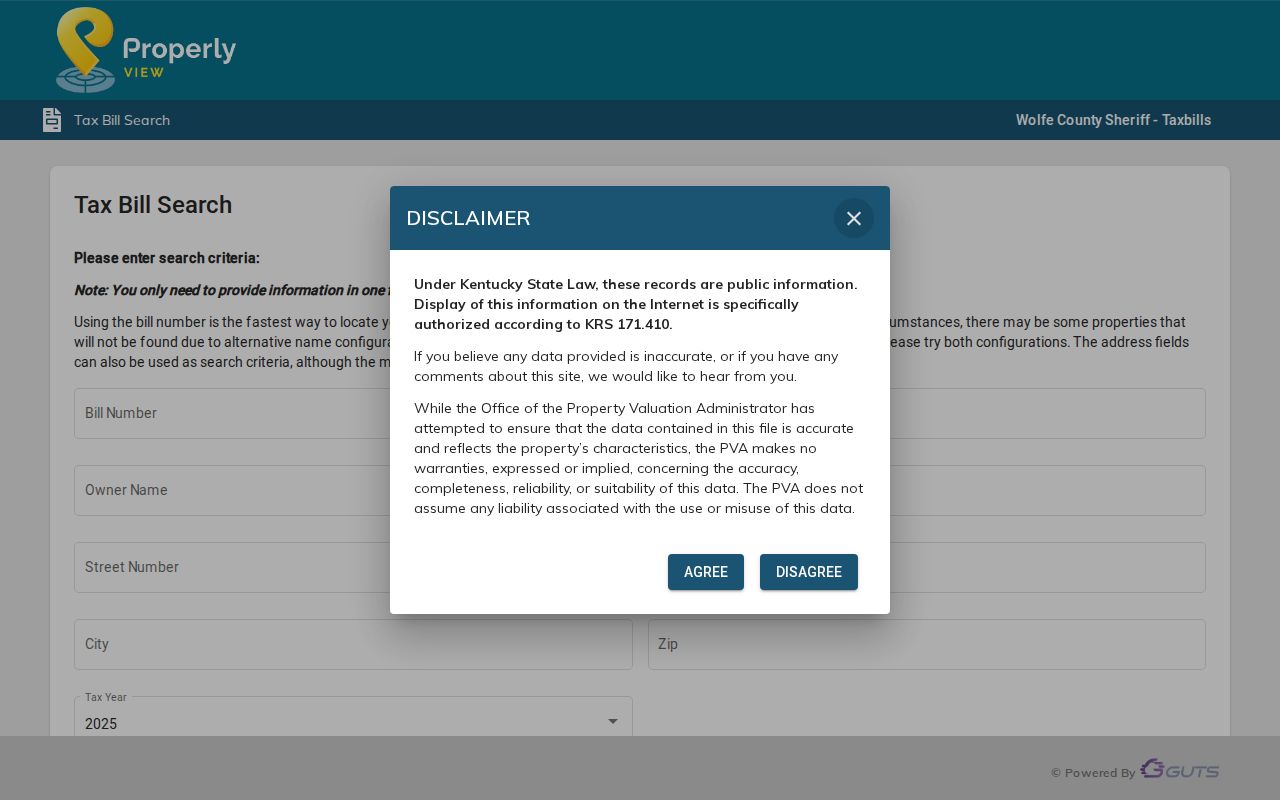
The landing screen confirms the county destination. It does not support inventing an owner field or claiming instant deed updates.
Wolfe County Ownership Record Sources
Different custodians answer different parts of ownership. The assessment roll gives a dated tax name. The recorded deed carries the conveyance and the legal description. Entity filings identify the business record, a court file explains a sale, probate transfer, or title judgment, and state GIS adds location context only.
| Where ownership appears | What it contributes | Currency or access |
|---|---|---|
| Wolfe PVA and tax roll | January 1 owner name, parcel/account, assessment context | PVDNet if available; PVA phone, email, or office fallback |
| Wolfe County Clerk | Latest grantee, deed date, book/page, and legal description | Clerk site, counter, phone, mail, or written records request |
| Kentucky Secretary of State | Entity status, filings, officers, or registered agent as available | Free public entity search; it does not prove land title |
| Court and probate records | Judgment, commissioner's deed authority, estate appointment | Judicial Indexes discovery; Wolfe Circuit Court Clerk for the file |
| GeoNet and KyCities | County, road, and city-boundary orientation | No verified Wolfe owner-linked parcel viewer |
No record here proves who lives at an address. A tax mailing address may belong to a trustee, lawyer, post-office box, family contact, or in-care-of recipient. Treat it as a correspondence clue.
Confirm Wolfe County's Latest Grantee
The Wolfe County Clerk is the county's title-recording hub. Search both grantor and grantee names. Include initials, spelling variants, and entity names. Ask for the newest conveyance tied to the same legal description, not just the newest deed under a similar name.
A Wolfe deed may state grantor, grantee, mailing addresses, consideration, legal description, source of title, preparation and return statements, and an in-care-of tax address. Read the later corrections too. Correction deeds, releases, easements, and court-related instruments all matter. Recording gives public notice of the instrument; deciding legal title can still require a Kentucky title examination.
Wolfe County Entity Property Owners
A Wolfe County deed grantee may be an LLC. The grantee may also be a corporation or trust. An estate or fiduciary can hold title too. Never swap in an officer, heir, trustee, or registered agent for the titled party. The Kentucky Business Entity Search links an entity name to public state filings. Search the exact organization name first. Then test spelling and status variations.
Business filings rarely hold trust details. An estate owner may require the probate appointment, will, affidavit, or fiduciary deed. A Wolfe County court judgment can alter rights and end in a recorded commissioner's deed. Each added record explains authority; none rewrites the grantee line.
Wolfe County Court Owner Changes
Foreclosure, quiet title, partition, boundary, and probate cases can change or explain the chain of title. Kentucky Judicial Indexes covers county, court, and party-name searching. Not every case is indexed, though. Search both sides, with spelling variants. Then take the case or accession number to the Wolfe Circuit Court Clerk.
Match the lis pendens to its case. Find the judgment or sale order. Then look for the commissioner's deed, sheriff's deed, release, or correction in the Wolfe land records. A docket alone is not a complete answer to who owns a parcel.
Wolfe County Owner Address Clues
Wolfe County searches usually start with geography that refuses to cooperate. Drop the road suffix and try the bare street number. Then work through Highway, KY Route, and US Route forms. Old community names, route labels, and ZIP clues fill gaps. A Campton post-office address is not proof the land sits inside the city limits.
Keep situs, mailing, in-care-of, tax, emergency, and legal-description fields apart. A creek, ridge, or road call often ties a parcel to the modern record. A parent tract can do the same. So can an adjoining owner named in an old deed. These clues sometimes beat any street label. Wolfe County property records reward that kind of patient cross-checking.
Note: A mailing address can separate same-name parties. But it is not proof of where a person resides.
Limits of Wolfe County Owner Lookups
A name in the tax roll proves very little by itself. It cannot show occupancy or confirm identity. It cannot reveal unrecorded claims, settle lien priority, fix a boundary, or guarantee marketable title. A quitclaim passes along only whatever interest the grantor held, if any. Paying the tax bill never cures a defective deed. A map label or the January 1 tax name cannot override a newer recorded instrument.
- Owner of record
- The party named by a particular official record as of that record's date.
- Grantee
- The party receiving the interest described in a deed or other conveyance.
- Title
- The legal rights in land, which may require more analysis than reading one public name field.
- Situs address
- The property's location address, distinct from the address used to send tax mail.
Use ownership records lawfully. Wolfe County owner data supports purchase, boundary, estate, and civic research. Never use it to stalk, harass, intimidate, or harm anyone.