
Wolfe County Deed Types
The Wolfe County Clerk records instruments that give public notice of interests in county land. The document type matters first. A warranty deed, quitclaim, correction deed, fiduciary deed, and commissioner deed do not all carry the same legal meaning. Each one serves a different purpose. The clerk's guidance walks through party addresses and legal descriptions. It also covers consideration certification, source title, preparation statements, and acknowledgments. Handle each of those fields when preparing or reviewing a deed.
| Deed type | What it does | Common context |
|---|---|---|
| Warranty deed | Conveys the described interest with stated warranties | Ordinary sale or transfer |
| Quitclaim deed | Conveys only the interest the grantor may have | Release or family transfer |
| Correction deed | Corrects a stated defect and cites the prior deed | Name or description correction; no added parties |
| Fiduciary deed | Shows a representative acting for an estate or trust | Probate or estate conveyance |
| Commissioner's deed | Records a court-authorized transfer | Foreclosure or partition |
Read the complete image once you pull it. Capture the granting clause, capacities, consideration, description, recording data, and every prior deed or plat reference it cites. A quitclaim, though, is never proof its grantor held good title.
Required Wolfe Deed Clues
The Wolfe ClerkInfo deed page turns Kentucky recording law into a practical checklist. KRS Chapter 382 supplies the statutory base. KRS 382.135 addresses deed content, consideration, and estate affidavits. A careful review keeps every field tied to the instrument itself rather than lifting out the names alone.
- Grantor and grantee names, addresses, and legal capacity
- Full legal description and acreage or lot references
- Consideration certificate and any transfer-tax exemption
- Source-of-title deed book and page
- Tax-bill address, preparer, acknowledgment, and recording data
A deed's stated consideration can signal a gift, a family transfer, a foreclosure exemption, or non-cash terms. It is a transaction clue, not a market appraisal. Kentucky law requires recording in the county where the land, or its greater part, lies.
Wolfe Mortgages and Releases
Wolfe County deed records should be read beside mortgages, assignments, modifications, and releases. Search the borrower's name and the lender or trustee too. Match every later release to the original book and page it cites. A partial release carries its own partial legal description. MERS changes go through the MERS route the clerk describes. The Wolfe mortgage guidance from the clerk's office explains the request wording.
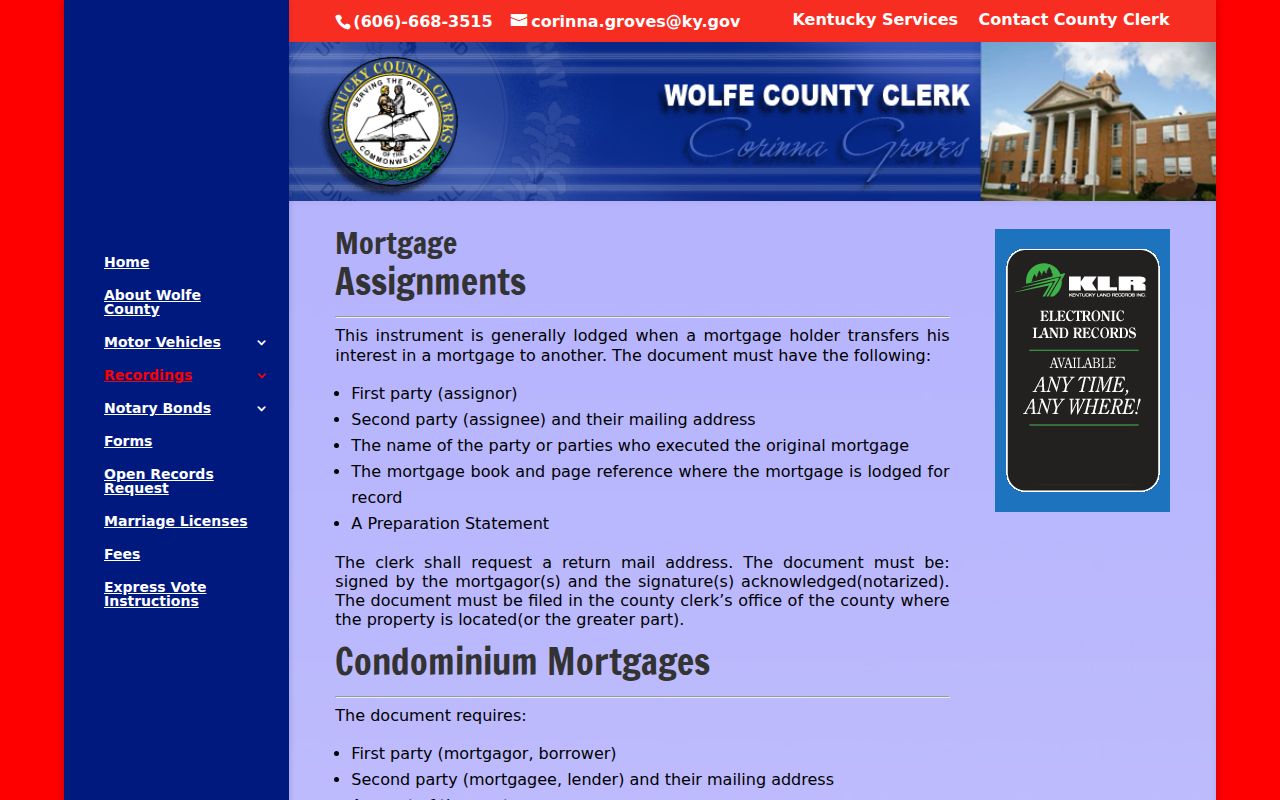
That page offers useful request vocabulary. It is not a parcel-level mortgage index, nor proof that an encumbrance remains open.
Wolfe Liens and Easements
The clerk records several kinds of liens. These include judgment liens, mechanic liens, tax liens, federal liens, Medicaid liens, and lis pendens notices. A lis pendens warns that title is in litigation. It does not prove a sale took place. Before deciding whether a filing still affects a tract, search later judgments, releases, commissioner deeds, and corrections. Easements should be indexed to both parties and to each parcel they touch. Capture the purpose, the legal description, the source title, and any later release. A road, utility, waterline, access, or drainage right shown on a plat should be checked against the separately recorded instrument. Note: A lien entry may be released, continued, expired, disputed, or changed by court action, so retrieve the full document.
The Wolfe Fire-Era Deed Trail
KDLA confirms courthouse disasters struck Wolfe County in 1886 and 1913. Fire hit the courthouse twice. A local account holds that the first blaze destroyed county records. Most papers came through the second one intact. The local inventory lists deeds rerecorded after the 1886 fire. A later recording date in Wolfe County deed records may actually preserve an older transaction.
Work the deed trail in three tracks whenever a chain reaches this era: the current clerk's book and page, KDLA microfilm and its index, and tax books or the local inventory. Label every item you use. It might be an original image. It might be a rerecorded deed, an index-only entry, a tax lead, or a historical reference. Pre-1860 land adds a wrinkle. Wolfe County was formed in 1860. The parcel may live first in a predecessor county's deed records.
Read Wolfe Grantor-Grantee Entries
A grantor conveys an interest; a grantee receives it. Search both sides independently. Start from the newest confirmed deed, follow its source-of-title clause back to the prior deed, and repeat until the chain runs out. Kentucky archive guidance suggests trying H for heirs, C for commissioner, and S for sheriff where those index conventions apply.
- Locate the latest likely purchase deed with the owner as grantee.
- Copy its grantor, deed type, recording date, book/page, description, and source title.
- Search that grantor as an earlier grantee, including initials, spelling variants, estate, trustee, and entity forms.
- Repeat while checking releases, easements, liens, plats, and court transfers along the chain.
- Grantor
- The person or entity conveying an interest.
- Grantee
- The person or entity receiving an interest.
- Chain of title
- The linked sequence of instruments affecting ownership.
- Book and page
- The clerk locator used to request a recorded image.
The public clerk pages describe documents but publish no verified grantor-grantee search form. Use the counter, phone, email, or mail when no online index exists.
Older Wolfe Deed Books
KDLA's inventory lists Wolfe deeds on microfilm from 1887 through 2002. The local inventory describes a 1913-to-present courthouse series. It also notes overlapping mortgage, encumbrance, will, commissioner, transfer, and tax volumes. Treat these ranges as leads only. Verify the current book or reel with the clerk or archive before relying on it.
Older deeds present a second problem. Before about 1890, a deed may lack the prior-recording reference. That reference is what makes a chain easy to follow. KDLA recommends tax records when that link disappears. Its Wolfe tax assessment holdings include runs from 1861 to 1862, 1865 to 1875, and 1879 to 1892. The Wolfe Public Library's census and local history materials can sort out people and old place names. They cannot prove title.
Wolfe Plats and Probate Links
Plats pack real detail into a single document. A Wolfe County plat can show lots, dimensions, streets, easements, dedications, and survey notes. A condominium deed may point to a master deed plus a cabinet or slide floor plan. The county publishes no online plat-image viewer. Bring a book and page or cabinet and slide reference to the clerk. Ask to inspect the original or get a copy.
Probate records pair naturally with Wolfe County property records when ownership passes through an estate. Wills appear in KDLA's microfilm inventory covering 1887 through 2004. A local inventory describes will books through 1995. Confirm which locator covers the period you need. Search under executor, administrator, personal representative, devisee, heir, commissioner, and trustee. Then match the deed or affidavit to the probate appointment, will, inventory, settlement, and any later conveyance.
Request a Wolfe Recorded Deed
Help the clerk zero in fast. Bring whatever locators you have: grantor and grantee names, an approximate year, the instrument type, book and page, a parcel or account number, a legal-description phrase, or a linked case. Mention possible name twists, including estates, trustees, MERS entries, and corporations. Say up front whether you want to inspect the record, get a plain copy, or order a certified copy. Also say whether referenced plats and attachments should be included.
The dated 2020 fee schedule lists $50 for a deed, $50 for a plat, $80 for a mortgage, and $46 for a release. It carries a warning that prices can change. Confirm the current cost before sending any funds. The counter sits at 10 Court Street. Staff also handle mail, phone at 606-668-3515, and email at corinna.groves@ky.gov. For older records, KDLA Records Requests serves as the historical fallback. It sets an expectation of four to six weeks.
Recorded, not guaranteed. Wolfe County deed records show what reached the public record, but they do not guarantee clear title or resolve every unrecorded claim.
Starting from an address and need the parcel number first? Follow the Wolfe County property search steps. For any transaction or dispute, have a Kentucky title professional review the deed chain.