
Trace Wolfe County Former Owners
Start from the newest recorded conveyance. Then step back one owner at a time. Each link in the chain should show who conveyed to whom, the kind of deed, the recording date, and the book and page where the recorder filed it. Wolfe County former owners hold up best when the legal description and the source-of-title clause match from one transfer to the next. A current tax roll name can point you to the newest record. The deed chain itself supplies the full historical sequence.
| Transfer Date | Grantor to Grantee | Deed Type | Book/Page |
|---|---|---|---|
| Newest transfer | Prior holder to present grantee | Read the recorded instrument | Copy the exact locator |
| Earlier transfer | Earlier holder to prior holder | Warranty, quitclaim, fiduciary, or other form | Follow the source-title reference |
| Estate or court step | Decedent, fiduciary, heirs, or commissioner | Estate deed, affidavit, or commissioner deed | Pair with the case file |
| Fire-era link | Names shown in a surviving or rerecorded entry | Original, rerecorded, or index-only evidence | Check clerk and KDLA holdings |
Treat this as a research worksheet, not an invented ownership history. Enter nothing unless it comes from the instrument itself or a clearly labeled index entry. Keep in mind that the execution date and the recording date can differ. A same-name match stays weak until the tract description, acreage, adjoining calls, or prior-deed reference fits too.
Wolfe Deed Sources by Era
Official historical coverage opens with Wolfe deed microfilm from 1887. The clerk publishes no confirmed online index cutoff. A local inventory describes courthouse deed books from 1913 forward. It notes that deeds were rerecorded after the 1886 fire. KDLA holds deed microfilm through 2002, though reels and gaps vary by series. These facts make the clerk and the archives complementary. They are not interchangeable deed records sources.
| Source | Documented Run | Access Route | Best Use |
|---|---|---|---|
| County Clerk deed books | Local series described from 1913 to present | Clerk office, 10 Court Street | Current books, certified copies, local indexes |
| KDLA deed microfilm | 1887 to 2002 inventory coverage | Archive request | Older owners and reel copies |
| Tax assessment books | 1861-1862, 1865-1875, 1879-1892 | KDLA and historical references | Pre-1890 owner leads when deeds lack source cites |
| Wills | KDLA inventory from 1887 to 2004 | Clerk, court, and KDLA | Estate transitions and heirs |
No single source proves every year is complete. Ask the Wolfe County Clerk or KDLA to confirm the exact volume, reel, image status, and certification options before you rely on an index-only hit.
Fire-Aware Wolfe Ownership Research
Courthouse disasters in 1886 and 1913 shape any ownership search here. Local history reports that the 1886 fire destroyed county records. Most records survived the 1913 fire. A deed recorded after 1886 may simply rerecord an earlier act. A later date does not always signal a new sale.
For a fire-era chain, tag each clue by type: original image, rerecorded deed, index-only entry, tax lead, or local historical reference. Search the current clerk book and page. Search the KDLA microfilm and index. Search the tax books in parallel rather than one after another. When party names, tract calls, and source references agree, they can explain an apparent jump in the deed records. That agreement still never replaces a title examination.
Note: The 1887 historical coverage is confirmed. No Wolfe online deed-index start year is established.
Read Wolfe Deeds Backward
The source-of-title clause bridges one owner to the next. Begin with a modern deed tied to the right parcel. Before opening the next link, read the grantor, the grantee, the legal description, the recording date, the consideration context, and the cited prior instrument in full.
- Use the parcel, current tax name, or known book and page to locate the newest deed.
- Record its grantor as the prior owner and copy the source-of-title reference exactly.
- Search that grantor as a grantee in an earlier period. Try initials, spellings, fiduciary forms, and “et al.”
- Repeat while the legal description stays tied to the same tract. At the web gap, move to clerk books or KDLA microfilm.
- Grantor
- The party conveying the stated interest.
- Grantee
- The party receiving the stated interest.
- Chain of title
- The ordered links of recorded transfers affecting one tract.
- Reverse index
- An index arranged to find a party on the receiving side of a conveyance.
- Quitclaim versus warranty
- A quitclaim conveys the interest held without a warranty; a warranty deed carries stated title promises.
Index Wolfe Names Three Ways
KDLA's deed handout recommends searching both grantor and grantee indexes. It also flags letter codes in some entries. H stands for heirs, C for commissioner, and S for sheriff where those conventions appear. Such entries matter. Ownership may have shifted through an estate, partition, foreclosure, or land sale instead of a plain private purchase.
Run each name several ways. Try the exact surname first. Then try the surname with a first initial, the full first name, a middle initial, a maiden or prior name, punctuation variants, and likely misspellings. Next, compare legal descriptions and mailing fields. A trustee, estate, corporation, or fiduciary may be the indexed party. A familiar individual name can still appear elsewhere in the file.
Wolfe Estates Break Straight Chains
Not every former owner connects through two ordinary deeds. The archive inventory lists wills from 1887 through 2004. The local series notes will books through 1995. Estate affidavits, fiduciary deeds, and commissioner deeds can fill the gap. Dower or division records and probate files can fill it too.
Open the probate branch with the Wolfe Circuit Court Clerk. Ask whether the matter is still held locally or was transferred elsewhere. Search the decedent in Kentucky Judicial Indexes. Keep in mind that not every case is indexed. A displayed civil date may not be the filing date. Pair any probate order with the conveyance recorded afterward.
An estate affidavit should name the decedent, the personal representative, and the recipients. It may also carry a value statement and a legal description. Shared surnames alone prove neither kinship nor a property interest. Verify the parcel number and tract calls before accepting the connection.
Wolfe Tax Books Bridge Gaps
Before about 1890, Kentucky deeds may omit a useful prior-recording reference. KDLA recommends tax records as the bridge. Wolfe tax assessment books survive for several runs before and after county formation. These include the early 1860s, parts of the 1860s and 1870s, and 1879 through 1892.
A tax-book name is a dated lead, not a deed. Use it to narrow an owner of record, district, tract, or time span. Then return to the land books, wills, court division files, and patents. For an early tract, the Kentucky Secretary of State Land Office extends the property records search. It reaches into land patents and predecessor-county materials.
Local Clues for Previous Owners
Old deeds raise questions that recorded title alone cannot answer. The Wolfe County Public Library keeps census material, vital records, and cemetery listings. Its shelves also hold family-history files and county-history works. The genealogy page lists Wolfe County Cemeteries 1860-1991, Volume I. It also lists county birth, death, and marriage books. Used alongside Wolfe County property records, these sources can separate two men with the same name. They can also track down an estate, or explain a community name written into an old deed.
The library genealogy collection gives researchers a practical starting point for that background work.
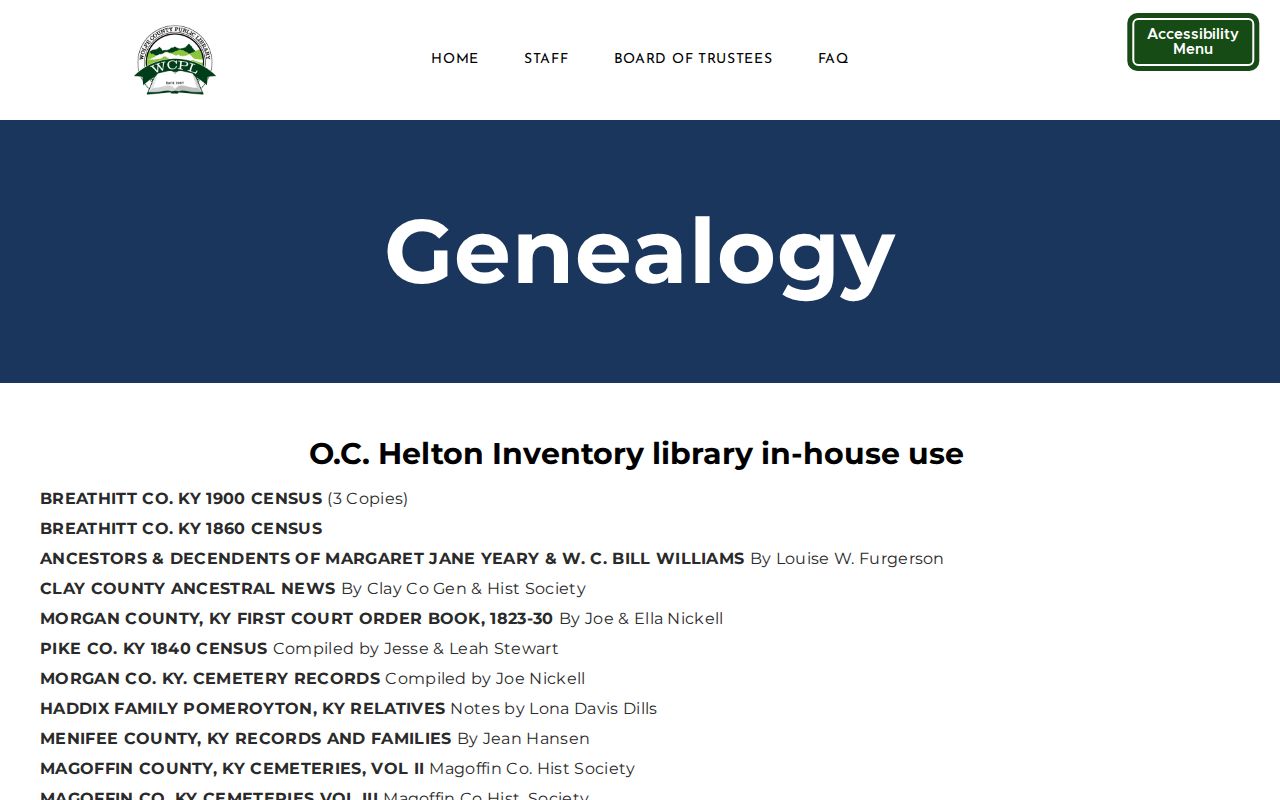
The library's genealogy page displays the kind of local shelf list that can support a deed chain in Wolfe County property records, while the recorded deed itself remains the true title source.
Wolfe Ownership Records Reach 1887
Recorded deeds in Wolfe County reach back to 1887. That is a historical baseline, not a claim about online coverage. A chain of title can run earlier through rerecorded instruments, land patents, tax assessments, wills, and predecessor-county records.
It can also stall. A missing volume, an index-only clue, or a metes-and-bounds description too vague to match can stop the search cold without a survey or title review.
Requesting archive service takes some preparation. Provide Wolfe County, the record class, the names involved, an approximate date, and any book, page, case, or tract clue you have. KDLA accepts mail, phone, and online requests. The search and copy fee is $20 for in-state requests and $25 for out-of-state, with possible page and postage costs added, and a four-to-six-week turnaround is the norm. Confirm current terms before you order.
Historical cutoff. Official research supports Wolfe deeds from 1887, but it found no verified online cutoff. Older work belongs in clerk books, KDLA microfilm, tax books, and patent records.