
Compare Wolfe County Property Values
Label each number first. Kentucky sets fair cash value as the assessment standard for ordinary real property in Wolfe County, and the PVA applies it parcel by parcel. Taxable value can drop with an exemption. Deed consideration is different still. That figure reflects one transfer, so its meaning depends on the deed type, and none of these numbers should quietly stand in for another.
| Value Type | Meaning | Record Source |
|---|---|---|
| Assessed value | Fair-cash assessment for the stated tax year | Wolfe PVA assessment roll |
| Taxable value | Assessment after an applicable exemption or adjustment | PVA and tax record |
| Market value | Probable exchange value under a stated valuation date and method | Professional appraisal; fair cash is the assessment standard |
| Last sale or consideration | Amount or value statement tied to a specific transfer | Recorded deed and consideration certification |
Wolfe County applies no half-value residential ratio. KRS 132.450 directs fair cash value instead. A PVA property card can hold several figures at once, from land and improvements to a total assessment, an exemption, and a final taxable value. The online card's labels deserve a live look. Do not treat any portal figure as a distinct market estimate until its label says so.
Fair Cash Guides Wolfe Assessments
Kentucky's fair-cash-value standard comes from KRS 132.450. For an ordinary Wolfe County parcel, the assessment aims to approximate fair cash value. It is not a fixed fraction of market value. The tax roll still needs a valuation date beside it. Kentucky sets January 1 as the assessment date. Market swings later in the year do not rewrite that figure.
A mass assessment applies one consistent public method across many parcels. A private appraisal studies a defined property for a stated purpose and date. The public record can move for several reasons. Physical changes, parcel splits, corrected characteristics, fresh sales evidence, or a new assessment cycle can all shift it. Keep the purpose and date next to the number.
PVDNet Value Fields Need Verification
The county's online entry point is Wolfe PVDNet. The portal runs as a client-side application, so parcel cards, field labels, sale history, and value detail load only inside a live browser session. A bare landing page hides a lot. It is not proof that anything is missing from the public record. Ask the PVA when a field will not appear.
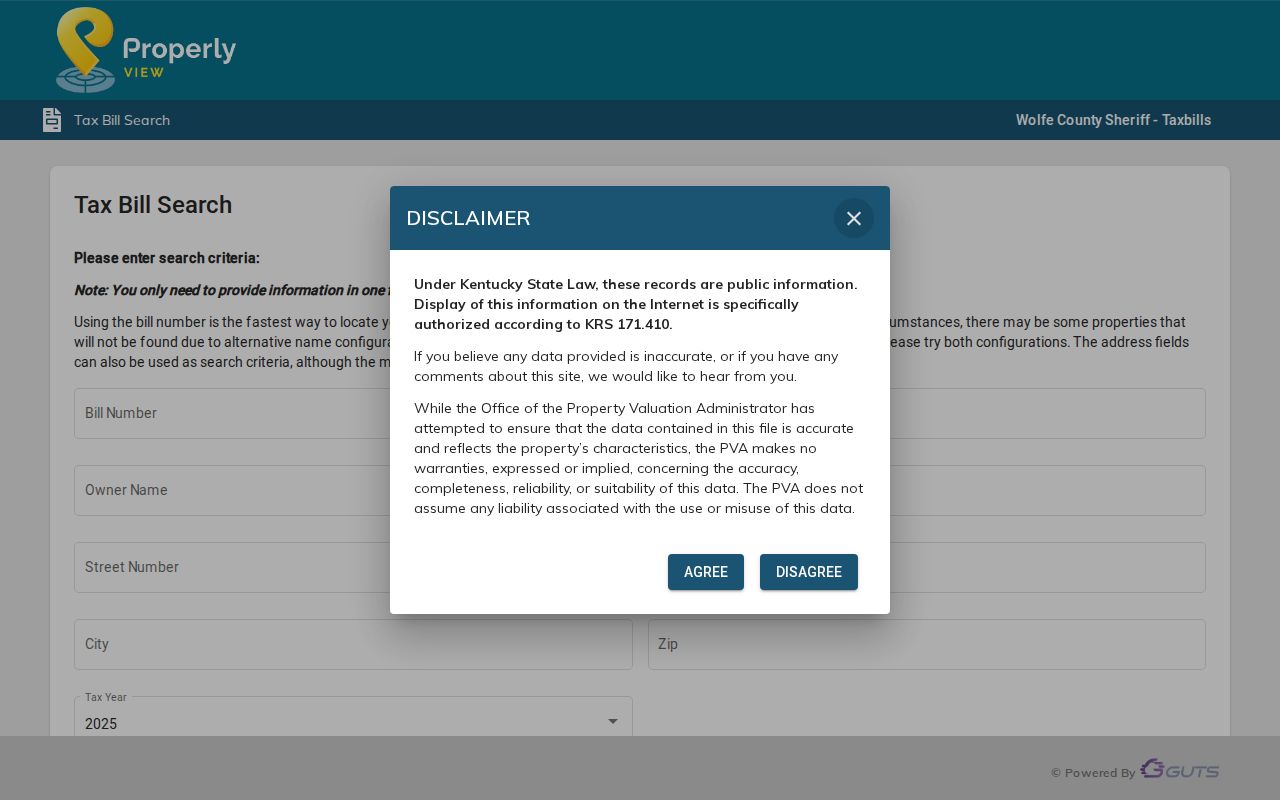
The page confirms its Wolfe County destination. Field labels are another matter, because the portal loads its details dynamically rather than printing them on the page. Verify each label in a live session.
Look Up Wolfe County Assessed Value
Start with a full situs address. Add any parcel or account number you have. Rural route names and mailing cities can stray from a property's legal location, so keep every address form instead of writing over one.
- Open PVDNet and test the address or parcel route. If it fails, call the Wolfe PVA at 606-668-6923 for the public locator.
- Record the tax year and copy only the value labels actually shown. Keep land, improvement, total, exemption, and taxable fields separate.
- Check the January 1 assessment context and note any parcel split, merge, acreage issue, or corrected property characteristic.
- For a transaction clue, retrieve the recorded deed from the County Clerk and read its consideration certification and transfer type.
- Assessed value
- The PVA's value under the fair-cash standard for the stated assessment year.
- Taxable value
- The amount remaining after applicable exemptions or adjustments.
- Assessment ratio
- The relationship between assessed and market value; Wolfe sources support fair cash, not a separate fractional ratio.
- Consideration
- The transaction amount or value statement recorded with a deed.
- Reassessment
- A later review or revision of the value on the assessment roll.
January 1 Dates Wolfe Values
January 1 anchors Kentucky's property calendar. The tax-bill owner is the January 1 owner. An in-care-of name may flag a later buyer. A deed recorded after January 1 is newer ownership evidence, but the annual assessment roll and its value stay tied to the earlier snapshot.
Timing matters here. A late-year transfer may reflect property condition or market facts that were never part of the January 1 record for a Wolfe County parcel. Keep every date separate. Sale date, recording date, assessment year, and later improvements each answer a different question about the same parcel.
Note: The Wolfe PVA makes no published promise about when midyear assessment refreshes appear on the roll.
Deed Consideration Is One Clue
The Wolfe County Clerk's deed guidance requires consideration and certification in many transfers. A full-consideration conveyance needs a sworn certification. Gifts and nominal transfers still need a fair-cash-value statement. Utility, court, government, cemetery, correction, family, and corporate transfers can follow their own treatment under the local guidance.
Read the deed type first. Consideration is not always a sale signal. A family deed, quitclaim, foreclosure, divorce transfer, estate conveyance, or noncash deal may say nothing about an open-market bargain. Compare the legal description, parcel changes, transfer-tax context, and any later improvements before trusting the number. The recorder's figure is not a current value by default.
The clerk's page puts transfer tax at fifty cents per five hundred dollars of value, borne by the grantor. Confirm current statute and clerk practice before calculating.
Wolfe Exemptions Change Taxable Value
A homestead exemption trims the taxable base for a qualifying owner. It does not touch the parcel's fair-cash assessment, and it sets no sale price. Kentucky Revenue lists a $49,100 exemption amount for 2025-26, available to a qualifying owner who is at least 65 or totally disabled.
File the application with the Wolfe PVA. Age proof can be a birth certificate, driver license, or passport. Disability proof depends on the qualifying basis, and certain veteran or total-permanent-disability cases follow different renewal patterns. Ask the PVA for the current form and evidence list before filing.
Comparing neighboring records? Use assessed value for a like-for-like read. A lower taxable value may simply reflect an exemption, not a weaker valuation.
Capture Wolfe Value Evidence
A solid value note captures the parcel or account identifier, situs, tax year, assessment date, land value, improvement value, total assessment, exemption, taxable value, and the portal's update or print date when those fields exist. Add the deed's recording date, deed type, consideration, and book or page only when a sale comparison matters.
PVDNet does not spell out its exact result labels. Do not fill absent fields with data from another Kentucky county. For a missing card, contact PVA Justina Trusty Smith at 10 Court Street, P.O. Box 155, Campton. You can also call 606-668-6923 and request the public assessment fields for a specific parcel and tax year.
Compare Wolfe Values With Facts
An old recorded price means little until you confirm the tract itself is unchanged. Partial conveyances, merged parcels, corrections, new improvements, and easements can all make a simple price comparison misleading. Acreage listed on a tax card is not a survey. A legal description reading "less and except" calls for the excluded instrument.
When reviewing a value, useful evidence includes recent comparable sales, condition details, measurements, photographs, surveys, and corrected property characteristics. These items help explain a number. They do not turn the public assessment into a private appraisal.
Limits of Wolfe County Property Value
An old recorded price means little until you confirm the tract itself stayed intact. Partial conveyances, merged parcels, corrections, new improvements, and easements can quietly distort a simple comparison. Acreage on a tax card is not a survey. A legal description reading “less and except” demands the excluded instrument.
Solid evidence for a value review includes recent comparable sales and condition details. Add measurements, photographs, surveys, and corrected property characteristics. Those materials help explain a Wolfe County assessment number. They never turn the public figure into a private appraisal.
Value is not price. A Wolfe County assessed value supports taxation. It is not a promise of sale price and is not a private appraisal.