
Begin a Wolfe County Records Search
A street address, tax name, or parcel account makes a good starting clue at the Wolfe County PVA and PVDNet entry point. The application runs as a client-side shell. If it fails to load, call the PVA instead. Ask for the parcel or account locator, the January 1 assessment owner, and separate mailing and situs fields. A situs address describes the land's physical location. That address need not match the one used for mail.
Carry the parcel number and owner name to the County Clerk. Deeds, mortgages, liens, plats, releases, easements, and powers of attorney there form the recorded chain of title. The Sheriff supplies the current tax bill. Kentucky GeoNet can help orient the tract. The county itself offers no confirmed owner-linked parcel viewer online. Each source has a narrow job.
- Try the address in PVDNet, then ask the PVA for an account locator if the web application fails.
- Write down the tax owner, situs, mailing address, legal-description clue, and assessment year as distinct facts.
- Search the clerk's grantor and grantee indexes, beginning with the newest deed and its source-of-title reference.
- Check the Sheriff's current bill and the clerk's delinquent-certificate files when tax status matters.
- Use GeoNet, the recorded plat, and a licensed survey when location or a boundary is at issue.
Wolfe County's Four Records Desks
The records work splits among four courthouse-area desks. The Wolfe County Clerk records title instruments. The Sheriff collects current property tax. The Property Valuation Administrator, or PVA, maintains the assessment and parcel-description data, while the Circuit Court Clerk holds foreclosure, quiet-title, boundary, probate, and judgment cases. Kentucky open-records law does not require one custodian to create a new report or certify another office's facts.
Wolfe County PVA
10 Court Street, P.O. Box 155
Campton, KY 41301
606-668-6923
Wolfe County Clerk Record Trail
The clerk's deed guidance sorts conveyances into several types. These include general warranty, special warranty, quitclaim, correction, fiduciary, and other types. A usable deed names the parties and their mailing addresses. It also states the consideration or its statutory basis, the legal description, and the source of title. That source often points to the prior deed's book and page. Search both directions in the index. Grantors convey an interest; grantees receive it.
Ownership work should also test the instruments around the deed. Mortgages can be assigned, modified, and released. Liens, lis pendens notices, easements, plats, and powers of attorney may explain limits. An ownership line alone can hide those limits. When an online image or index is unavailable, call or visit the clerk. Request a book-and-page check. Ask about copy or certification options.
The Wolfe County Clerk website identifies the office and its recording role. It serves as the official starting point for deed research in the county. Confirm hours and copy procedures there before any visit.
Confirm hours and copy procedures on the live site.
When Wolfe County PVDNet Stalls
PVDNet appears to be Wolfe County's online assessment and tax route, but it loads as a dynamic application shell rather than a ready parcel card. That gap matters. Another county's richer version proves nothing here. Try a normal browser session first. Then preserve the URL and the exact error or blank state you see.
The offline route is clear. Contact PVA Justina Trusty Smith at 606-668-6923 or Justina.Smith@ky.gov. Ask for the parcel or account number, the assessment owner, situs and mailing addresses, land and improvement values, the total assessment, exemption status, and any legal-description clue on file. The state directory lists office hours of 7:30 to 4:00 on Monday, Tuesday, Thursday, and Friday, and 7:30 to 1:30 on Wednesday. Confirm those hours before a visit.
| Clue to Preserve | Why It Matters | Next Record |
|---|---|---|
| Parcel or account | Stable cross-office locator | PVA and tax file |
| Assessment owner | January 1 tax-roll lead | Newest recorded deed |
| Situs address | Physical location clue | Map and legal description |
| Mailing address | Notice destination only | Do not infer residence |
Wolfe Assessment Name Versus Deed
Kentucky assessments snapshot ownership and value on January 1. A deed recorded later that year may be newer than the name printed on the tax bill. Neither record is defective. Note the tax year, the deed execution date, and the recording date before calling it a conflict.
Treat the assessed owner as a lead. Confirm the newest grantee in the clerk's record, read the source-of-title clause, and check for later correction or fiduciary deeds. An estate, trust, company, or commissioner may call for a court or Secretary of State cross-check. Report conflicting sources with their dates. Avoid picking the name that merely looks familiar.
Key distinction. The tax owner supports assessment work; the latest valid recorded conveyance supports the title chain.
Wolfe County Property Record Types
No single Wolfe County property record answers every question. A deed documents a conveyance. An assessment supports taxation. A tax bill reports the collection state for a tax year, a plat depicts a surveyed division, and a court file may explain a forced sale, probate transfer, boundary dispute, or judgment. Match the question to the keeper and preserve the record date.
| Record Type | What It Documents | Kept By | Access |
|---|---|---|---|
| Deeds | Conveyance, parties, legal description | County Clerk | Clerk office and recorded books |
| Mortgages and liens | Secured claims, notices, releases | County Clerk | Instrument indexes and copies |
| Assessment and tax | January 1 owner, value, exemptions, bill | PVA and Sheriff | PVDNet, phone, or counter |
| Plats and map context | Lot geometry and location clues | Clerk and GeoNet | Recorded plat and state viewer |
| Campton land use | Zoning, subdivision, permit decisions | City of Campton | City request; no register found |
Title history starts with the focused Wolfe County deed records route. Value, exemptions, collection, and the annual calendar belong to the county's property tax records. Compare the two; never blend them.
GeoNet Orients Wolfe County Parcels
Kentucky GeoNet publishes statewide map viewers and mapping services for every county. Its help material covers search, layers, geocoding, coordinates, measurement, import, printing, and sharing. The state county-boundary service can place Wolfe County on the map. KyCities can display Campton's incorporated boundary. The state publishes no Wolfe-specific public parcel ownership map. Parcel detail still comes from the PVA and the recorded deed.
Treat map evidence with care. Save the layer name. Save the date, the scale, the coordinates, and a copy of the map view. Then match that location against the PVA parcel clue. Match it also against the legal description in the deed. A web measurement is an orientation aid, never a legal boundary opinion. Recorded plats and a current survey carry different evidentiary weight in Wolfe County property records.
- Parcel
- A tract or assessment unit identified by the PVA.
- Plat
- A recorded drawing that depicts lots, dimensions, roads, or easements.
- Situs
- The physical location of land, which may differ from its mailing address.
- Assessed value
- The value used in the tax process, not a sale appraisal.
Campton Address Is Not City Proof
Campton is the county seat and the only incorporated city in Wolfe County. A Campton postal address can still serve land outside the city limits, though. ZIP 41301 marks a mail delivery zone, not a boundary. That distinction decides whether city zoning, subdivision, floodplain, or permit records exist at all. Before relying on an address, check the KyCities boundary viewer. When the edge matters, ask Campton for a written determination. County assessment and recording still run through the PVA and the County Clerk.
A Campton property search works best when it settles the boundary question first. Hazel Green and Malaga hold no incorporated city status here. Their Wolfe County property records stay at the county level.
Note: A mailing city, a city boundary, a tax district, and a deed description are separate facts. Log them apart.
Wolfe Courthouse Fires Shape Research
Wolfe County was formed in 1860. Local accounts describe courthouse disasters in 1886 and 1913. Those fires change how a title search works. A clean modern index cannot be assumed to carry every older deed link. Some deeds were rerecorded after the losses. Surviving tax, will, mortgage, encumbrance, lease, sale, and transfer books can supply indirect clues to ownership. They help when a deed is missing.
The Kentucky Department for Libraries and Archives holds Wolfe land-record microfilm beginning in 1887. It also holds will material from later periods. Its request route covers transferred historic holdings. Charges for search and copy work are stated. A four-to-six-week response window applies. For an older chain of title, give KDLA the names, approximate years, record types, and any known book or tax clues. Search predecessor-county material too when the claimed title predates 1860. The Wolfe County Public Library genealogy collection adds census copies, county birth, death, and marriage books, cemetery material, family histories, church histories, diaries, and local-history works. These sources can tie a surname to a place, but they convey no title to land.
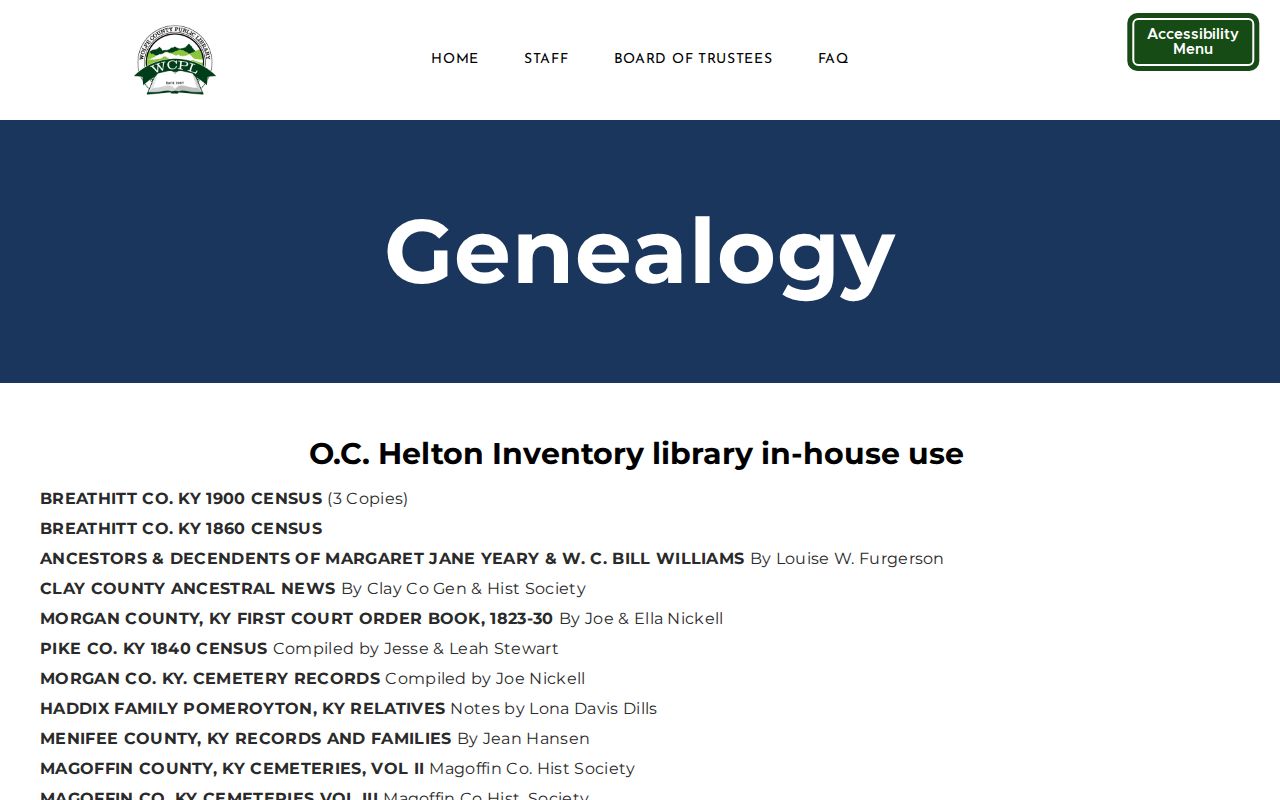
The library page is a collection guide. Read its cited sources alongside the deed and tax books before drawing conclusions about Wolfe County property records.
Wolfe Tax Sale Is Not Title
The Sheriff collects current taxes in Wolfe County. After the statutory cycle, delinquent certificates move into the County Clerk and county-attorney process. The county's sale notices distinguish sale years from sale dates. A delinquent list identifies a tax claim and its stage. It does not mean the parcel is free to take. Nor does it name the final title holder on its own. Read the notice year, registration rules, certificate details, and any later court or deed record. Redemption can change the outcome. Assignment, litigation, and a later conveyance can too. A careful Wolfe County property search keeps the assessed owner, the certificate purchaser, and the recorded grantee in separate columns. The documents must connect them.
Wolfe Court Files Explain Changes
Property disputes sometimes land in the Wolfe Circuit Court Clerk's office. Non-routine transfers may land there too. The address is 133 Main Street. Circuit files can cover foreclosure, partition, quiet title, boundary disputes, liens, probate, and judgments. Kentucky Judicial Indexes and CourtNet offer statewide entry points. An index result is a lead, though, not a final order. Search every known spelling of each party name. Record the county, division, case number, filing date, and disposition. Then request the complaint, order, judgment, or deed that bears on the land. Some older files sit at the State Records Center or KDLA. Others were destroyed under an approved retention schedule. So ask the clerk where a specific file is held.
Request Wolfe Records With Precision
The Kentucky Open Records Act, KRS 61.870 through 61.884, frames every public request. A strong request names an existing record, the custodian, the parcel or party, the record type, and a date range. It also states whether inspection or copies are sought. Broad questions invite delay. No agency must research a chain, answer a legal question, or build a custom list for you.
Aim each request at the right office. Assessment questions go to the PVA. Current payment questions go to the Sheriff. Instruments and delinquent certificates belong to the County Clerk. Case files belong to the Circuit Court Clerk. Campton keeps its own municipal zoning and subdivision files. Preserve the request, the response, and any redirect, because that paper trail shows which office claimed custody of the Wolfe County property records and what each one searched.
Limits of Wolfe County Property Records
Wolfe County property records carry real weight. Each piece answers only part of the question, though. Recorded grantees, assessment names and values, tax status, liens, easements, plats, and court activity all appear somewhere. The deed records, tax roll, and plat books each hold a share. No single entry tells the whole story, though. A mailing address does not prove where someone lives. An assessment is not a market appraisal. A GIS map polygon is not a survey. An index hit does not prove the contents or legal effect of the document behind it. For a purchase, boundary dispute, estate, or broken chain of title, pull the actual instruments. Consult a Kentucky title or survey professional.
Public access has limits under KRS 61.878 and other laws. Kentucky Safe at Home offers a substitute-address program. The statute does not make real-estate holdings confidential, though.
Lawful use. Wolfe County records support property research, due diligence, estate work, and civic transparency. Never use owner data to stalk, harass, or harm a person.